











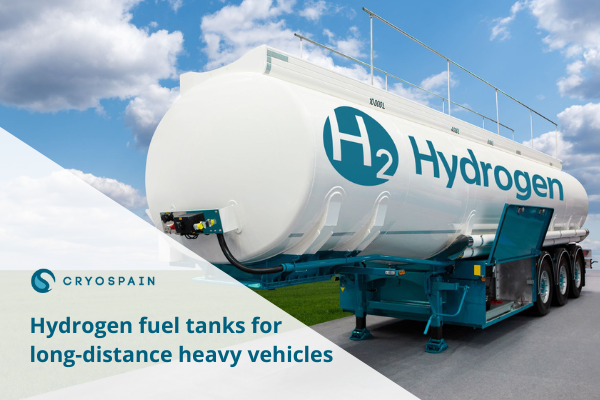
The possibility of developing efficient hydrogen fuel tanks lies at the heart of facilitating greener, more sustainable long-distance heavy transportation.
In order to advance in this direction, companies must have access to cost-efficient and safe liquid hydrogen storage tank models.
We take a look at current hydrogen transportation possibilities and what a hydrogen fuel tank needs to offer to move forward in this direction.
Hydrogen fuel tanks are essential for enabling long-distance, zero-emission heavy transportation. From 700 bar compressed systems to liquid hydrogen cryogenic tanks, efficient storage is key to reaching 300+ mile driving ranges.
What are hydrogen fuel tanks?
A hydrogen fuel tank is a specialized storage system designed to safely contain hydrogen either in gaseous or liquid form, depending on the application and required energy density.
Hydrogen can be stored in two main ways:
- Compressed hydrogen gas, typically at pressures up to 700 bar, commonly used in passenger vehicles and smaller mobility applications.
- Liquid hydrogen (LH₂), stored at cryogenic temperatures of approximately –253 °C, where hydrogen is maintained in its liquid state to significantly increase energy density.
While compressed hydrogen systems are currently widespread, liquid hydrogen storage offers substantially higher volumetric energy density, making it particularly attractive for long-distance transportation, heavy-duty mobility, aerospace, and maritime applications.
Cryogenic liquid hydrogen tanks are designed with advanced thermal insulation systems, often incorporating vacuum insulation and multilayer insulation (MLI) to minimize heat ingress and reduce hydrogen boil-off during storage and transfer.
Selecting the appropriate hydrogen storage solution depends on several factors, including energy density requirements, available space, safety considerations, refueling infrastructure, and operational conditions.
For applications such as long-haul transportation, storage technology becomes especially critical. Liquid hydrogen systems allow vehicles to carry greater amounts of usable hydrogen within a smaller volume, enabling longer driving ranges while maintaining manageable tank sizes.
What are hydrogen-powered vehicles?
Hydrogen-powered vehicles use hydrogen as an energy carrier to produce electricity or mechanical power.
Most hydrogen vehicles operate using fuel cell technology, where hydrogen reacts with oxygen in a fuel cell stack to generate electricity. The only byproduct of this process is water vapor, making hydrogen vehicles a zero-carbon emission solution at the point of use.
You may like: Revolutionizing the aeronautical industry with liquid hydrogen
In addition to fuel cells, hydrogen can also be used in hydrogen combustion engines, which are currently being explored for heavy-duty transport.
Hydrogen fuel tanks are therefore a core component of these vehicles, as they determine the vehicle’s range, refueling time, and operational efficiency.
Are hydrogen-powered trucks better for long distance transport?
The option of using hydrogen-powered trucks has received growing attention in light of a global effort to reduce CO2 emissions. This is particularly true for heavy vehicles, which are considered to be responsible for around a fifth of CO2 emissions from road transport in the EU, and 6% of EU carbon emissions overall.
As such, hydrogen-powered vehicles overcome many of the limitations of both gasoline and electric vehicles, including the following:
- Zero CO2 emissions (only water vapor)
- Renewable energy potential
- Short refueling times
- Extended usage with heavy loads
- No acoustic or visual pollution
Challenges working with hydrogen fuel tanks
Despite its advantages as a clean energy carrier, hydrogen storage remains technically challenging.
Under ambient conditions, hydrogen has very low volumetric energy density, meaning that storing sufficient quantities for long driving ranges requires either very high pressures or extremely low temperatures.
In compressed gaseous form, hydrogen requires large storage volumes and heavy high-pressure tanks, which can limit its practicality in transport applications where space and weight are constrained.
Liquid hydrogen (LH₂) storage significantly improves volumetric energy density, but it introduces cryogenic engineering challenges. Hydrogen must be maintained at approximately –253 °C, requiring advanced insulation systems to prevent heat ingress and minimize hydrogen boil-off.
Cryogenic hydrogen tanks are therefore designed with vacuum-insulated double-wall vessels, often combined with multilayer insulation (MLI) to reduce thermal losses. Managing pressure build-up, boil-off gas, and thermal stresses, along with boiling off induced by sloshing of LH2 becomes a critical part of the tank design and operational strategy.
Additionally, the infrastructure required for liquid hydrogen handling, transfer, and fueling must maintain cryogenic conditions throughout the entire system, including storage tanks, transfer lines, pumps, and fueling interfaces.
Know more about compressed hydrogen: tips for handling and storing it
For this reason, the industry continues to develop advanced cryogenic storage technologies that increase hydrogen density while ensuring safety, reliability, and operational efficiency for mobility applications.

Compressed hydrogen vs liquid hydrogen
| Feature | Compressed Hydrogen (700 bar) | Liquid Hydrogen |
| Storage form | High-pressure gas | Cryogenic liquid |
| Typical pressure | Up to 700 bar | Near atmospheric |
| Storage temperature | Ambient | ~ -253°C |
| Space efficiency | Lower | Higher |
| Typical use | Passenger vehicles | Heavy-duty transport |
| Long-distance range | Limited | High |
Two main hydrogen storage technologies are currently used in transportation. Compressed hydrogen is currently the most widespread technology, particularly in passenger vehicles.
However, liquid hydrogen storage offers significantly higher energy density, making it a promising solution for heavy-duty trucks, aviation, and long-distance transport applications.
How Cryospain can help with hydrogen fuel tanks
At Cryospain, we bring extensive experience in cryogenic engineering and hydrogen infrastructure, supporting companies developing hydrogen storage and transport solutions.
Our engineering teams design and manufacture advanced cryogenic systems capable of handling liquid hydrogen safely and efficiently.
These storage solutions are ideal for hydrogen production plants who need access to the right systems to store liquid hydrogen.
By analyzing the specific requirements of each project, we can provide complete solutions covering the entire project lifecycle, including:
- Commissioning and operational assistance
- Engineering and system design
- Manufacturing of cryogenic equipment
- Integration and installation support
Related content: Importance of liquid oxygen systems in the medical and pharmaceutical industry 7
This turnkey approach allows our partners to implement reliable hydrogen storage infrastructure tailored to their operational needs
Cryogenic hydrogen equipment for industrial applications
Cryospain develops specialized equipment designed to operate under the extreme conditions required for liquid hydrogen.
Our solutions include:
- Vacuum-insulated piping systems (VIP)
High-vacuum insulated piping significantly reduces heat ingress, allowing liquid hydrogen to be transported safely while minimizing boil-off losses. - Cryogenic storage tanks
Engineered to maintain cryogenic temperatures and ensure safe hydrogen storage for industrial and mobility applications. - Cryogenic pump systems and transfer equipment
Designed for efficient hydrogen handling, including transfer, loading, and distribution operations. - Hydrogen fueling and loading systems
Supporting the growing infrastructure required for hydrogen mobility and industrial applications.
By combining advanced cryogenic engineering with decades of industry experience, Cryospain helps customers implement hydrogen systems that are safe, efficient, and scalable.
Want to learn more about Cryospain and how we can help you achieve efficient storage systems for hydrogen-powered vehicles? Get in touch with us and let our technical team know about your needs.