






The arrival of LNG as a fuel for maritime transport has emerged as one of the unstoppable trends of recent years.
In a context where 80% of global goods are transported by sea, LNG-powered vessels are becoming the sector’s clear response to the need to reduce emissions and comply with environmental regulations.
Some figures illustrate the significant changes that LNG ships are bringing to commercial dynamics. On one hand, the demand for LNG-powered vessels has been on the rise in recent years: in just the first 6 months of 2025, 87 new ships were planned, compared to 53 in the same period in 2024, according to Sea LNG. The same organization estimates the current number of dual-fuel vessels (LNG ships that also use conventional fuels) at 1,369.
You may also be interested in: LNG Bunkering Stations for shipping
The IEA, in turn, speaks of “an imminent wave of liquefied natural gas (LNG) production capacity that is set to transform market dynamics”: thanks to the growing maturity of the infrastructure required for LNG supply, a significant increase in the availability of this cryogenic fuel is expected, as well as a notable reduction in its prices.
In this context, we now focus on the cryogenic systems that can enable this new paradigm in maritime transport. To do so, we explore topics such as cryogenic thermal insulation solutions, strategies for the efficient management of Boil-Off Gas (BOG), and the technologies that help improve energy efficiency and reduce emissions linked to the energy transition for LNG vessels.
Cryogenic systems for Liquefied Natural Gas (LNG) fuel in the maritime sector
What is LNG fuel and how it impacts the maritime industry
LNG, or liquefied natural gas, is natural gas that, when cooled to cryogenic temperatures (–161 °C), reaches its liquid state. It is also known as LNG, for its initials in English.

Composed mainly of methane, in its liquid form it has a volume 600 times smaller than natural gas at ambient pressure and temperature, which facilitates its transport and storage.
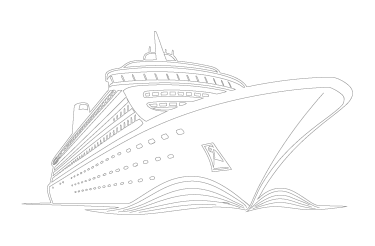
In the naval sector, this element is enabling the emergence of LNG vessels, ships powered by LNG that offer reduced emissions compared to conventional fuels.
This is especially important in a context where the reduction of emissions linked to the energy transition has gained prominence in the maritime industry, driven by IMO regulations.
You may be interested in: Green hydrogen and cryogenics: a new challenge for Cryospain
In this regard, LNG is estimated to reduce CO2 emissions by between 20% and 30% compared to conventional fuels, in addition to eliminating sulfur oxides (SOx) and reducing emissions of nitrogen oxides (NOx) and fine particulate matter.
This positions it as a “bridge fuel” capable of initiating the transition toward a less polluting maritime industry, while additional technologies are developed to achieve more significant reductions.
Why LNG ships require extreme cryogenic conditions
For its effective transport and storage, LNG must be kept at extremely low temperatures (–161 °C). This requires cryogenic systems capable of efficiently maintaining these temperature levels.
Key components on LNG and gas carriers: tanks, materials, and insulation for LNG transport
- Cryogenic tanks and membrane tanks: cryogenic systems designed to maintain cryogenic conditions through insulation systems, as well as safety and venting measures.
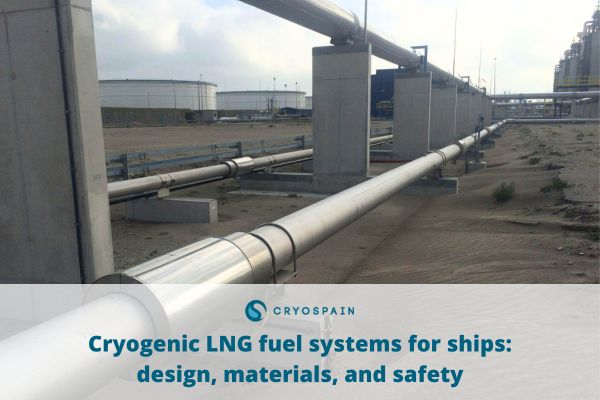
- Vacuum-insulated pipes: used in various processes, including the transport of LNG from the bunkering station to the tanks, delivery to the boilers, and in venting and ventilation systems.
- Innovative insulating materials: this includes solutions based on cellular glass, expanded perlite, or rock wool.
- Multilayer insulation technologies: an insulation method that uses multiple layers to maintain temperatures while minimizing heat transfer.
Safety and boil-off gas (BOG) management on LNG ships
Safety in LNG transport involves the proper management of the phenomenon known as Boil-Off Gas or BOG.
This is the gas naturally generated due to heat entering the tanks, which causes the liquefied natural gas to evaporate. It is a substance composed mainly of methane that must be managed correctly.
Keep learning: Everything you should know about storing liquefied natural gas (LNG)
Main risks and protective measures for LNG carriers
In addition to affecting the LNG, the heat input and subsequent evaporation of LNG are associated with a series of risks:
- Increase in internal tank pressure, with the risk of causing structural damage.
- Risk of fire or explosion in the presence of undetected BOG.
- Environmental risks in the case of uncontrolled venting, as methane is a greenhouse gas.
BOG generation and utilization solutions on LNG ships
Modern LNG vessels incorporate various systems to control the evaporation and generation of Boil-Off Gas (BOG), even being able to use it as an energy source.
Since venting is the least sustainable solution (as BOG is a greenhouse gas), the main management solutions include:
- Using BOG as fuel.
- Management through reliquefaction systems.
Energy efficiency and innovation in LNG transport and LNG fuel optimization
Cryogenic design to reduce thermal losses on LNG ships and carriers
Cryogenic design for LNG ships must focus on reducing thermal losses to improve energy efficiency, maintain the properties of LNG, and minimize the generation of Boil-Off Gas (BOG).
To achieve this, cryogenic systems should provide:
- Thermal insulation solutions that prevent losses through advanced techniques and materials.
- Cutting-edge cryogenic tank and piping design, with specialized components such as valves and pumps.
- Temperature and pressure control systems.
Technologies to reduce emissions and optimize operations on gas carriers
- More efficient combustion engines.
- Thermal energy recovery systems, capable of converting heat into useful energy, such as electricity.
- Systems for utilizing BOG as fuel.
- Use of alternative fuels derived from LNG, such as bio-LNG. Derived from the liquefaction of biomethane, it allows for a significant reduction in emissions and is compatible with existing LNG infrastructure.
- Technologies to capture carbon and other harmful emissions and reduce them before release. An example is the system proposed by Park et al. (2024), capable of “simultaneously mitigating CH4, NOX, and CO2 emissions” in LNG vessels.
Advanced cryogenics and the role of Cryospain in LNG carrier solutions
Specialization in cryogenic systems design and manufacturing for LNG ships
At Cryospain, we bring our decades of experience in designing cryogenic systems to support the advancement of LNG in the naval sector.
To this end, we focus on the design and manufacture of cutting-edge cryogenic technology for LNG vessels.
Some of our projects position us as key partners in a maritime industry striving toward green shipping.
- Design of vacuum-insulated piping systems for LNG cruise ships
- Design and manufacture of piping for a retrofit project and a new build
- Comprehensive projects for LNG vessels
With the technical and production capacity to design and implement customized cryogenic systems, we ensure the provision of solutions for the transport and use of LNG in the maritime context. This includes the design of custom storage tanks and piping systems, incorporating all safety considerations and complying with international standards.
Innovative solutions for LNG ships and safe operations
At Cryospain, we put cutting-edge cryogenic technology and engineering at the service of the energy transition in the maritime sector, supporting both new-build and retrofit projects.
Contact us to find out how we can help your naval project take full advantage of LNG.