



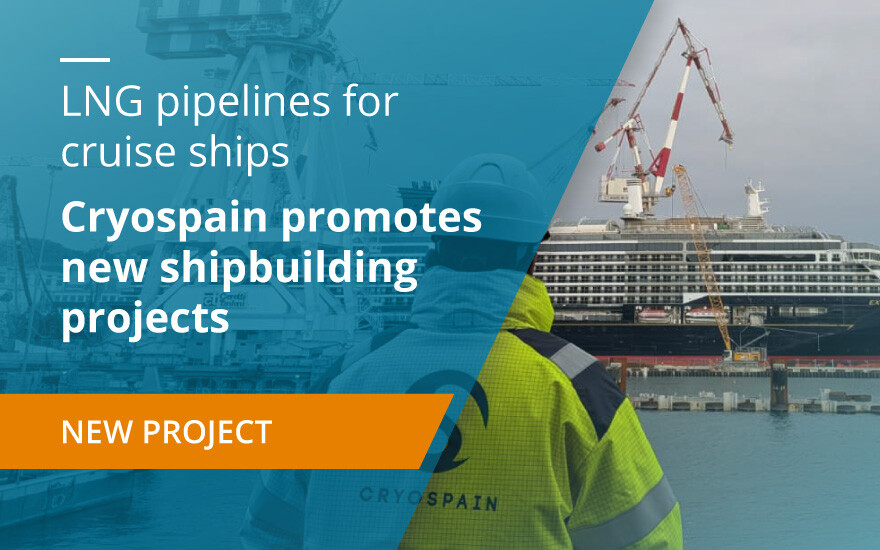
Cryospain continues to consolidate its role in the development of advanced cryogenic solutions through its participation in the design, manufacture, and installation of liquefied natural gas (LNG) piping systems for cruise ships built in leading European shipyards.
This project represents a significant step in the evolution of the maritime sector toward more sustainable models, in which LNG is positioned as a key alternative for reducing emissions and improving energy efficiency in maritime transport. In this context, Cryospain contributes its expertise in integrated solutions for cryogenic systems, covering everything from the engineering phase to the commissioning of onboard installations.
Discover our comprehensive cruise ship project as well: one more step toward green maritime transport
Initially, Cryospain was contracted to develop the engineering for the LNG piping. As the project progressed, its involvement was gradually expanded to also include the manufacture and installation of the systems on several newly built vessels.
It is also a particularly relevant project due to its technical and logistical complexity, as it is carried out in different phases and locations within the shipbuilding process. This has required a high level of coordination, adaptability, and technical control at every stage.
Technical characteristics of the LNG piping system
Complete systems for onboard LNG management
The solutions developed by Cryospain cover all needs related to LNG handling on board the vessels:
- Tank filling systems (bunkering)

- Interconnections between LNG tanks with vacuum insulation
- Venting systems for pressure control
- Double-wall piping for gas supply to engines and boilers
This comprehensive approach helps ensure a safe, efficient, and continuous fuel supply under all operating conditions.
Detailed engineering for marine cryogenic systems
One of the most notable aspects of the project has been the development of detailed engineering for the LNG/NG piping system, a key phase for ensuring the reliability, safety, and integration of the installation within the vessel.
In this area, Cryospain has worked on:
- Detailed engineering of the LNG/NG piping system, including the complete design of single-wall and double-wall lines, accessories, supports, and integration with the vessel’s general arrangement.
- Mechanical and stress analysis of cryogenic and high-pressure piping under operational, thermal, and vessel-motion loads, in accordance with applicable regulations.
- Thermal assessment of cryogenic penetrations to ensure a safe interface with decks and bulkheads, preventing low-temperature damage to surrounding structures.
- Development of support, spool, and installation deliverables, with the technical documentation required for manufacturing, onboard assembly, testing, and commissioning.
This engineering work makes it possible to anticipate construction constraints, optimize shipyard assembly, and ensure the correct performance of the system during vessel operation.
Cryogenic insulation and operational safety
The piping design incorporates advanced insulation solutions, especially in the interconnections between tanks, where vacuum insulation is used to minimize thermal losses.
Likewise, double-wall piping ensures the safe transport of gas, reducing the risk of leaks and guaranteeing system integrity in a demanding environment such as the marine sector.
Compliance with international maritime regulations
All systems have been designed in accordance with the most demanding standards in the sector, including the IGF Code for the use of low-flashpoint fuels on ships.
In addition, the work has been certified by the classification society RINA, ensuring compliance with the safety, quality, and reliability requirements demanded for this type of installation.
You may also be interested in: Cryogenic systems for LNG: design, materials, and safety on ships
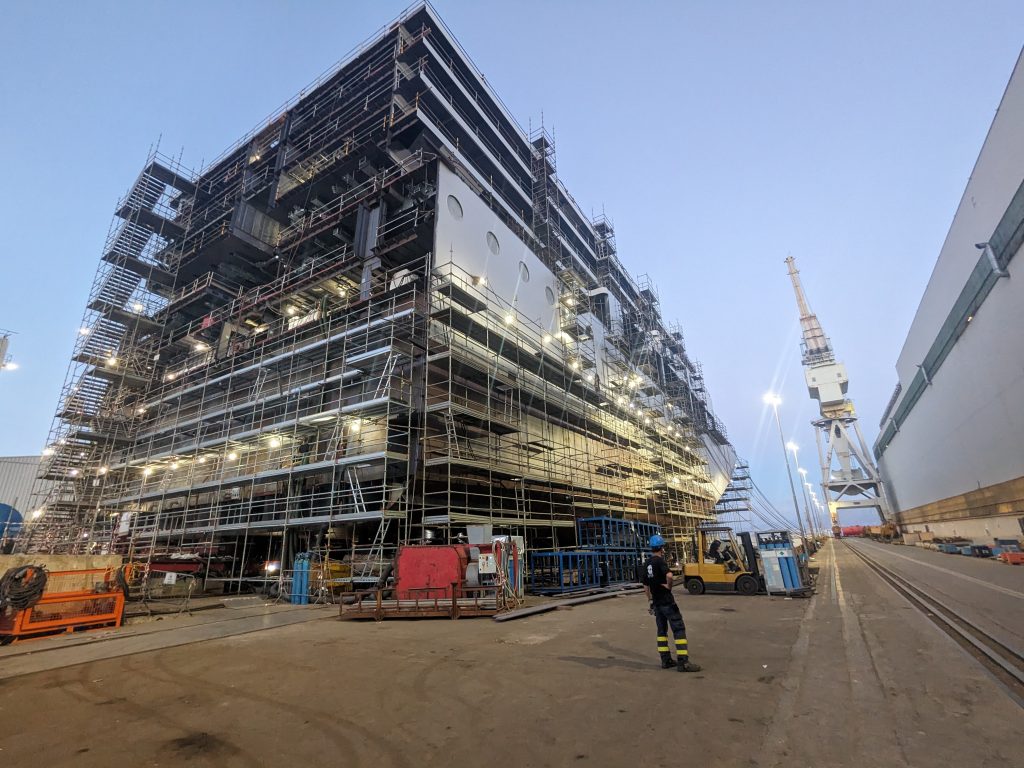
Execution across multiple European shipyards
One of the main challenges of the project has been its execution in different locations within a distributed shipbuilding process:
- Palermo, Italy: manufacture of the bow section
- Tulcea, Romania: manufacture of the stern section
- Genoa, Italy: final assembly of the vessel and system connection
- Sestri, Italy: piping installation in new blocks
Cryospain has participated both in block construction phases and in onboard works, including piping connections between sections, system cleaning, and integration with the vessel’s equipment.
The role of LNG in new-generation cruise ships
The incorporation of LNG as a fuel responds to the growing need to reduce the environmental impact of maritime transport.
In this context, the systems developed by Cryospain make it possible to:
- Reduce pollutant emissions compared with traditional fuels
- Improve the energy efficiency of vessels
- Guarantee a safe and continuous fuel supply
- Comply with the sector’s new environmental regulations
You may be interested in: Energy transition in the marine world. Cryospain participates in the change toward a better world
A milestone for Cryospain in shipbuilding
This project represents a turning point in Cryospain’s trajectory within the marine sector. Participation in newly built vessels marks a significant step forward in its ability to take on comprehensive gas piping system projects, substantially expanding its technical and operational scope.
Until now, its experience had been focused mainly on retrofit projects. Its involvement in newbuild projects not only entails greater integration into the construction process, but also the ability to participate from early engineering phases, coordinate work across multiple locations, and respond to the demands of contemporary shipbuilding.
The experience gained in projects of this kind further strengthens Cryospain’s position as a leading technology partner in cryogenic solutions for the marine sector, especially in the field of LNG systems for new-generation vessels.