



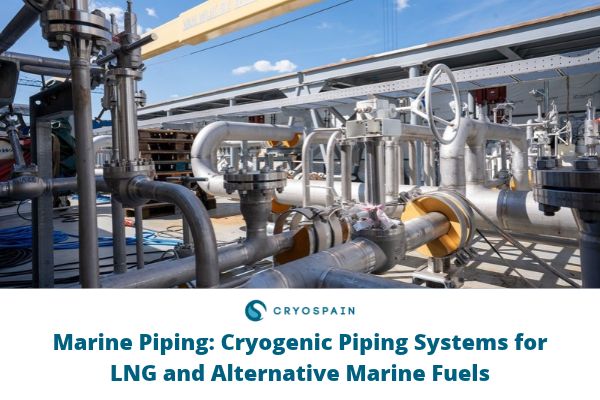
Marine piping stands out as a key piece in the puzzle of marine engineering, as responsible for achieving the safe and efficient handling of fuels and fluids on board ships and in marine applications.
Due to the unique conditions encountered at sea, marine piping installations present specific requirements in terms of materials, engineering and safety. At the same time, the rise of alternative marine fuels such as LNG, ammonia and liquid hydrogen has implied sophisticated cryogenic technology for new marine fuels is now required.
In this context, the following article provides an overview of the unique needs of piping systems in ships, with a particular focus on the engineering requirements for cryogenic piping systems used for LNG fuel systems and other emerging alternative marine fuels.
What is marine piping and why is it critical to ship operations?
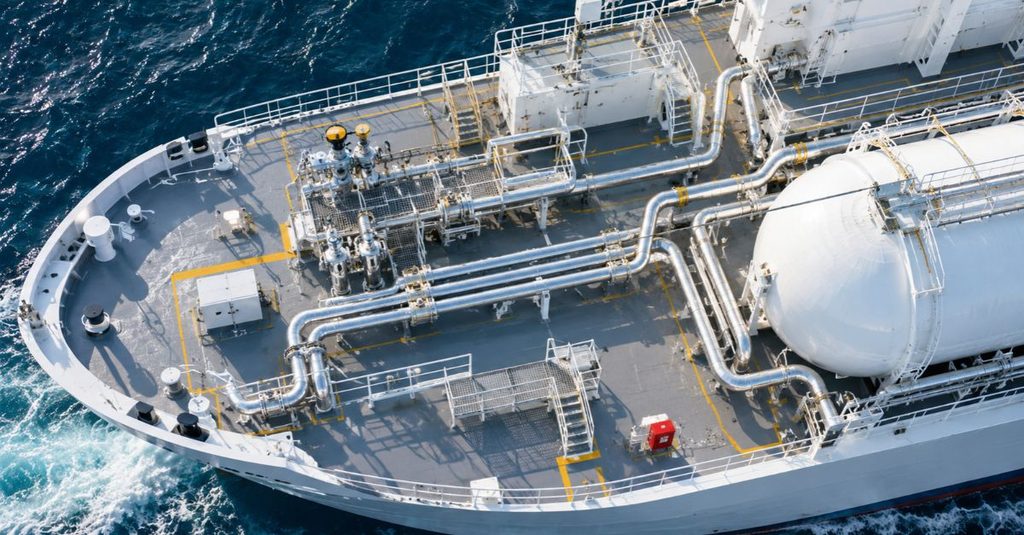
Marine piping systems involve networks of pipes, valves, fittings and other technical components whose purpose is to facilitate the transmission of substances (fluids or gasses) necessary for ship propulsion, cargo handling, safety and other everyday vessel operations.
These networks are essential for modern operations and marine engineering, with a variety of roles: from being part of ship fuel systems and bunkering systems, to seawater and freshwater cooling circuits, lubrication and hydraulic systems, ballast and bilge networks, firefighting systems, compressed air, freshwater and wastewater services. Certain vessels also incorporate dedicated marine piping for handling liquid cargoes, vapour return, inert gases and other process fluids.
Additionally, marine piping systems are seeing important transformations as alternative marine fuels continue expanding. Such is the case of LNG-powered ships as well as those powered by liquid hydrogen and ammonia, all of which must necessarily introduce specific cryogenic pipeline technology.
Marine piping design: key engineering requirements
Design choices around marine piping installation are directly conditioned by the operating conditions and the specific substances they will deliver.
For instance, cryogenic liquid lines require suitable low-temperature materials and insulation; meanwhile, gaseous marine fuel piping systems may require ventilated secondary enclosures. At the same time, whatever the specific requirements, these must also be adequately integrated within the overall ship fuel system.
The main marine engineering factors to consider when designing piping systems include:
Materials for pressure, temperature and corrosion resistance
Some of the extreme conditions expected in a vessel must be thoroughly analyzed and incorporated into marine piping design, including:
- The mechanical loads of ship motions, machinery vibration and hull deformation
- Pressure, weight and thermal movements
- The corrosion challenges generated by the marine environment
- Adequate control of fuel leaks, so that piping design integrates containment, ventilation, detection and isolation requirements within the vessel’s safety arrangements.
Routing, flexibility and space constraints on board
Space constraints also influence ship piping design, with routes having to accommodate structural members, bulkhead penetrations, equipment interfaces, escape routes and maintenance access.
Safety, reliability and maintainability
All components in a vessel must follow strict safety and reliability standards, and marine piping is no exception, with fires, leaks, ship breakdowns or environmental pollution being key risks to account for.
In order to do so, it’s crucial to incorporate norms like those by the International Maritime Organization (IMO), IGF Code or the International Convention for the Safety of Life at Sea (SOLAS), as well as all other applicable standards for safety and reliability.
At the same time, while installation processes must factor in shipyards’ construction and retrofit schedules, ship piping design must account for maintenance requirements and facilitate access.

Cryogenic piping systems for LNG and other low-temperature marine fuels
The rise of new alternative marine fuels comes with its own set of required adaptations in marine engineering, so that marine piping design incorporates these substances’ technical needs.
In this context, the main challenges when it comes to cryogenic ship piping systems in vessels involve maintaining mechanical integrity, limiting heat ingress and managing leakage throughout the system’s operating life.
Here’s a look at each of the specific challenges and solutions:
Challenges of transporting cryogenic liquids on ships and how to overcome them
Marine fuel piping systems designed for cryogenic liquids must consider how materials, welds, cryogenic valves and seals must remain operational at the lowest design temperature and while also withstanding the demands of marine environments.
In practice, this means thermal insulation measures for marine pipe systems must necessarily acknowledge aspects like the following:
- Cooldown causes thermal contraction, which must be accommodated without excessive loads on piping, supports or connected equipment.
- Repeated operating cycles require attention to fatigue.
- Insulation performance must be understood as depending on the complete installation, so that the thermal bridges introduced by supports, joints, branches and cryogenic valves must be included in the thermal assessment.
- When it comes to thermal movement and vessel loads, both the process pipe and any surrounding jacket or enclosure require assessment, including their supports and connections.
When looking at how to approach marine piping design adequately and address its challenges, it’s fundamental to establish the needs derived from the system’s fluid composition, design pressures and temperatures, flow rates, allowable pressure drop, operating cycles and equipment interfaces.
Additionally, engineering assessments for thermal insulation must cover wall thickness, material suitability, thermal contraction, support reactions, nozzle loads, hydraulic performance and heat ingress.
On top of this, fabrication, transport, onboard assembly and maintenance access must also be considered, while applicable flag-state and classification requirements must necessarily be incorporated into the design basis.
The specific needs of low temperature liquids: managing heat ingress, pressure and boil-off gas
In order to maintain extremely low temperatures, advanced cryogenic pipelines achieve thermal insulation through vacuum insulated and double-wall piping systems.
Put simply, vacuum insulated piping consists of an inner process pipe and an outer jacket separated by an evacuated annular space. This vacuum thus substantially reduces heat transfer through gas conduction and convection, while reflective multilayer insulation reduces radiation. Additionally, standard vacuum insulation must be distinguished from double-barrier containment systems, which require specific design.
This type of system allows for reducing total heat ingress, which limits unwanted vaporisation and helps maintain the required fluid condition during transfer.
However, it’s important to acknowledge and effectively address the following aspects:
- Heat ingress, which can still take place through supports, connections and other thermal bridges.
- Adequate measures for preventing boil-off gas, so that boil-off gas is managed, captured, or vented. Vapour and boil-off gas handling depend on the overall fuel-system arrangement, with potential destinations including a suitable tank or vapour return system, fuel consumers or dedicated gas-handling equipment.
- In terms of pressure issues, effective insulation reduces heat ingress and associated vapour generation, but it does not eliminate the need for pressure management.
During transfer, pressure, temperature and flow must remain within the intended operating envelope. Meanwhile, cooldown and standby procedures must account for vapour formation as warm piping cools or heat enters idle sections.
Additionally, liquid trapped between closed valves requires particular attention, as warming can produce a substantial pressure increase. Suitable thermal relief must therefore protect sections that can be isolated while full of liquid.
Marine piping systems for LNG, hydrogen and ammonia: their specific needs
LNG piping and bunkering systems: types of systems and their requirements
As LNG has been introduced as an alternative marine fuel, LNG fuel systems, LNG bunkering and LNG transfer systems have become increasingly common.
In fact, projects such as Cryospain’s LNG pipelines for cruise ships or the vacuum-insulated piping project for LNG bunkering in two port terminals confirm leading shipyards are already successfully integrating LNG piping systems as part of their operations.
Regarding the specific uses, cryogenic pipeline technology is used for LNG bunkering lines, for connections between fuel tanks and transfer pumps, and for liquid supply to vaporisers and fuel preparation equipment.
More specifically, when considering the specific design requirements for LNG piping in marine infrastructure applications, the following aspects emerge:
- Fixed piping is associated with shore-to-ship and ship-to-ship LNG transfer systems.
- Cold vapour and return lines can also require low-temperature design, depending on their operating conditions.
- Different sections of a fuel system can require different piping technologies. For instance, liquid LNG transfer may use vacuum insulated piping, while downstream natural gas supply may use ventilated double-wall piping.
- LNG bunkering design involves transfer equipment, emergency shutdown interfaces, operating procedures and personnel competence, aspects addressed by ISO 20519:2021 for LNG-fuelled vessels.
Liquid hydrogen piping requirements
As hydrogen ships are emerging as alternative options in the marine sector, it’s important to consider how liquid hydrogen introduces its own set of challenges, mainly due to its boiling temperature being approximately −253°C at atmospheric pressure.
The low-temperature piping specifications that apply for LNG cannot automatically be transferred to liquid hydrogen piping. In this type of projects, material compatibility, leak tightness, insulation and the potential for air condensation on inadequately protected cold surfaces require specific assessment.
Wins like Cryospain’s vacuum insulated pipes for liquid hydrogen in Rotterdam confirm that viable systems exist provided the right design, manufacturing and implementation measures are ensured.
Ammonia fuel systems and the next generation of alternative fuels
The safe transfer of ammonia in marine piping requires a particular emphasis on toxicity, alongside pressure, temperature and flammability. Additionally, refrigerated and pressurised ammonia arrangements also create different thermal and mechanical requirements.
Again, this means piping for ammonia fuel systems should be developed around the fuel’s specific hazards and operating conditions, with existing LNG or hydrogen arrangements not being valid without reassessment.
More specifically, when assessing ship piping design for ammonia applications, the following should be considered:
- Materials, cryogenic valves and seals require specific compatibility assessment.
- The installation must address secondary enclosure, leak detection, ventilation, isolation and protection of occupied areas.
- Purging, draining and maintenance procedures must minimise personnel exposure.
- Release management is especially important, with IMO’s ammonia guidelines calling for a suitable ammonia release mitigation system to handle releases from sources including fuel-piping relief valves, purging, draining and double-block-and-bleed arrangements.
Safety and regulations for marine piping systems
IMO, IGF Code and classification society requirements
Organizations like the International Maritime Organization (IMO) and the International Convention for the Safety of Life at Sea (SOLAS), as well as the IGF Code provide the main safety framework for ships using gases or other low-flashpoint fuels:
- The IGC Code addresses ships carrying liquefied gases in bulk, and its application must be distinguished from the IGF framework.
- Fuel-specific guidance includes IMO MSC.1/Circ.1687 for ships using ammonia as fuel and MSC.1/Circ.1701 for ships using hydrogen as fuel. Additionally, IMO approved the hydrogen interim guidelines in May 2026.
- Supporting standards may include ISO 20519 for LNG bunkering and engineering codes such as ASME B31.3, ASME B31.12 or EN 13480, where applicable and accepted.
Inspection, testing and documentation requirements for marine piping must be established against the applicable project codes and classification rules. In practice, this means applicable editions and approval requirements must be established considering each project’s specifics.
Leak detection, ventilation and emergency shutdown systems
Marine piping system design must be aligned with all potential safety considerations, including relief discharge destinations, backpressure and emergency shutdown sequences, as well as shutdown valve timing accounting for pressure transients during transfer.
When it comes to cryogenic piping systems specifically, safety requirements include protecting adjacent hull structures from low temperatures, appropriate electrical bonding and pressure relief for sections that can be isolated while full of liquid.
Cryogenic marine piping by Cryospain: proven engineering for real-world operations
Cryospain’s marine engineering capabilities have proven to be key allies for marine piping projects where vacuum insulated, ventilated and conventionally insulated piping are required.
Some of our initiatives for cryogenic piping technology adapted for marine environments include:
- Engineering, supply and installation of 160 m of DN100 vacuum insulated piping and 115 m of DN100 ventilated piping in our Nápoles . Baleària / Gibdock project in 2018
- Engineering, supply and installation of 100 m of vacuum insulated piping and 50 m of ventilated piping, DN100 for Sicilia – West Sea Estaleiros in 2021.
- Engineering and supply of 103 m of vacuum insulated piping for tank connection space, vent mast and bunkering applications, DN15–DN100 for a LH₂ project in 2020.
- Engineering, supply and installation of 600 m per vessel of vacuum insulated and ventilated LNG/natural gas piping, for Fincantieri H6321 and H6322 in 2023.
- Delivery of high-pressure hydrogen lines with ventilated enclosures for a Fincantieri vessel and current work on other hydrogen projects.
Across all our projects in the marine sector, we put our cryogenic engineering expertise to work, providing piping design, stress and thermal calculations, prefabricated vacuum insulated spools, valves, installation, commissioning and complete piping packages, and defining along with the customer the design pressures, temperatures and routing.
Want to discuss your marine piping project?
Get in touch with Cryospain to speak to our team and start considering how we can help you achieve the project’s required design needs.