










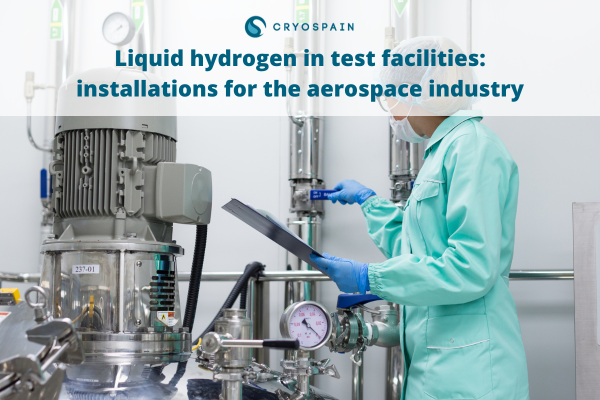
Liquid hydrogen test facilities stand as a key component within the framework required for the advancement of the aerospace industry.
The hydrogen test facility is a fundamental link in the chain that ultimately enables the use of a critical element: liquid hydrogen. And why is that? Because it is in these facilities where systems based on liquid hydrogen can be validated and their safety guaranteed, while also working to improve their efficiency.
Liquid hydrogen has already played a part in aerospace history, having been used in the iconic Apollo program to propel humans all the way to the Moon. Behind the scenes, work carried out in test facilities such as NASA’s Rocket Laboratory had enabled experimentation with liquid hydrogen as a high-energy propellant as early as the 1940s.
Today, at a time when the IEA describes the progress of green hydrogen as experiencing “unprecedented momentum”, experimentation with this element in test facilities is opening doors that were once unthinkable. This includes the possibility of more sustainable, lower-emission aerospace travel, as we discussed in our podcast on hydrogen as an energy vector.
From this perspective, in this article we aim to explore the use of liquid hydrogen in test facilities as part of the aerospace industry, addressing the needs of these installations both in terms of their design and their operation.
Use of liquid hydrogen in the aerospace industry
Liquid hydrogen is at the core of several fundamental processes that drive the advancement of the aerospace industry today.
On the one hand, it has become an essential propellant for space launches for decades. At the same time, this element is also part of experimental processes aimed at developing new forms of propulsion, such as nuclear propulsion.
Likewise, research is also being carried out on the use of liquid hydrogen in fuel cells capable of providing energy resources, electricity, heat, and even water, in space stations.
Keep learning: Revolutionizing the aeronautical industry with liquid hydrogen
What is a hydrogen test facility?
Test facilities can be defined as laboratories where tests are carried out to simulate the real conditions that components and systems will face during their operation. An example is NASA’s Glenn Research Center, considered one of the pioneering test facilities in the aerospace industry.
In the case of liquid hydrogen test facilities, these are installations designed to observe equipment that comes into contact with this element. The goal is to examine their performance in a controlled environment before real-world use, with the aim of validating or improving them.
Components such as valves, pipelines, or sealing and transfer systems are subjected to tests to verify how they react in dynamic environments, including their response to vibrations, pressure changes, and wear or aging.
To achieve this, test facilities are adapted to the technical and safety requirements involved in handling liquid hydrogen, which we detail further below in this article.
Design and operation of liquid hydrogen test facilities
Essential components and safety in cryogenic test facilities
Cryogenic systems are one of the fundamental elements in any liquid hydrogen test facility, due to the extremely cold temperatures at which this element must be stored and handled.
From vacuum-insulated pipelines and cryogenic valves to liquid hydrogen storage and cooling systems, every component and detail is essential to ensure safe and efficient operations.
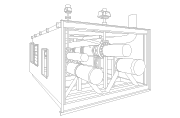
The selection and design of components is a complex process, as can be seen in Cryospain’s project for the design and manufacture of liquid hydrogen skids used to inject LH2 into propulsion engines on a test bench.

Likewise, we can mention the loading systems for cryogenic tankers specifically designed for hydrogen, such as the one developed by Cryospain, which require work at multiple levels, including:
- Selection of metal structures
- Design and manufacture of super-insulated piping
- Integration of valves, specialised instruments, and control panels.
These systems must necessarily be accompanied by safety measures to prevent the specific risks present in a hydrogen test facility. These include everything from leak-detection measures (such as the use of hydrogen sensors) to safety valves or controlled ventilation protocols, among others.
Likewise, safety standards and applicable regulations are an essential part of any test facility, including:
- ISO 13985:2006: Liquid hydrogen — Land vehicle fuel tanks
- UNE-ISO 14687:2006: Hydrogen as a fuel — Product specifications
- CGA H-3: Cryogenic Hydrogen Storage
- ASME Boiler and Pressure Vessel Code
Key procedures in space testing and aerospace testing
- Study of insulation and thermal protection systems
- Testing of cryogenic liquid transfer and flow systems, including cryogenic pipelines
- Valve testing
- Testing of insulating materials
- Testing of temperature and pressure sensors
Advantages and challenges of liquid hydrogen in test facilities
The reduced weight of liquid hydrogen, its speed in charging processes, and its low impact in terms of emissions (its combustion only releases water vapor) stand out among the most evident advantages of this element in the aerospace industry.
However, accessing all these advantages necessarily requires overcoming some of the most significant challenges of using liquid hydrogen, including:
- Ensuring safety in the face of its high flammability and the risk of leaks or explosions.
- Designing storage technologies capable of operating efficiently at extremely low temperatures (-253 °C). Among the most important requirements of these advanced cryogenic storage systems is the ability to avoid boil-off losses through the use of adequate cryogenic insulation and cooling systems. Likewise, careful design is needed to ensure that materials and systems can withstand extreme conditions.
Cryospain: pioneers in cryogenic solutions for the aerospace industry
With 20 years of experience at theforefront of cryogenic engineering, Cryospain stands out as a strategic partner in advancing the use of liquid hydrogen in the aerospace industry.
Successful projects, such as our cryogenic liquid hydrogen tank for an aerospace project in Germany and our involvement in an innovative liquid hydrogen production and supply plant in Canada, demonstrate our technical expertise.
As specialists in custom cryogenic engineering projects, we are able to design and implement tailored solutions aligned with the specific needs of each project.
All of this is guided by a highly qualified technical team, ready to provide our clients with cutting-edge cryogenics, prioritizing safety and efficiency.
Do you want to learn more about our capabilities in liquid hydrogen for the aerospace industry and test facilities?
Get in touch with us and speak with our team about how we can help you develop your project.